
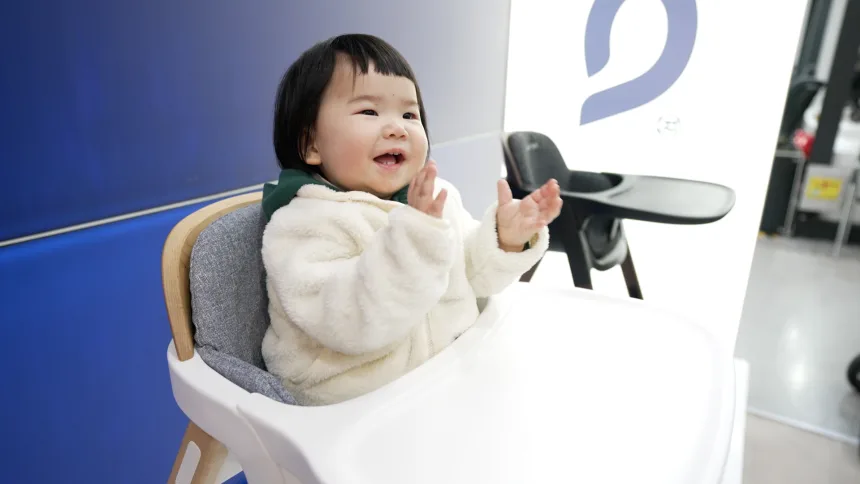
Seoul, South Korea – At a crowded convention center in Seoul, young couples weave through aisles of baby gear, fastening infant carriers, pushing strollers across test tracks, and learning the newest car-seat safety features.
The scene, unfolding in January, feels at odds with the headlines that have dominated South Korea for years — dire warnings of collapsing birth rates and a demographic crisis threatening not only Korea, but also neighboring Japan and China.
Yet, quietly and against expectations, South Korea is seeing more babies being born. For more than a year now, birth numbers have inched upward, offering a rare moment of optimism for a government that has poured billions of dollars into pro-natalist policies over the past decade.
Whether this rebound can endure remains uncertain.
Visitors at the Seoul baby fair acknowledged government incentives such as subsidies and parental support programs. Still, nearly all spoke of the immense difficulty of raising children in a society grappling with soaring living costs, punishing work hours, rigid gender roles, and deeply rooted conservative attitudes.
“After I got pregnant, I quit my job,” said Yun So-yeon, 31, who is expecting her first child in March. “There really wasn’t another option. When someone becomes pregnant at my workplace, they end up leaving.”
Nearby, 34-year-old Park Ha-yan, a stay-at-home mother expecting her third child in June, was blunt about the challenge. “At the end of the day, it’s about money,” she said.
“The more children you have, the more government support you get — but the expenses rise even faster. And those costs don’t stop after a year or two. They last until the children grow up, and that’s a heavy burden.”
Demographers urge caution before declaring a turnaround.
“We’re seeing a rebound, yes,” said Sojung Lim, Korea Foundation Professor of Korean Studies at the State University of New York at Buffalo. “But we still haven’t returned to pre-Covid levels. South Korea continues to have the lowest fertility rate among advanced economies.”
South Korea’s fertility rate — the average number of children a woman is expected to have in her lifetime — has fallen steadily since 2015. By 2023, it had dropped to a record low of 0.721, intensifying national alarm. Former President Yoon Suk Yeol even labeled the decline a “national emergency.”
That’s why 2024 came as a surprise. The fertility rate rose slightly, to 0.748 — the first increase in nine years. The jump was modest, but enough to spark hope that the country might be emerging from its population crisis.
The trend has continued. For 17 consecutive months, South Korea has recorded year-on-year increases in monthly births, according to government data released in January — a sign the fertility rate could rise for a second straight year.
Several factors may be driving the change.
Many couples delayed marriage and childbearing during the Covid-19 pandemic, Lim explained. In South Korea, births outside marriage remain rare, meaning fewer weddings translate directly into fewer babies. Now, those postponed plans may be moving forward, creating a post-pandemic “catch-up effect.”
Demographics also play a role. The children of South Korea’s Baby Boomers form a relatively large generation, meaning there are currently more women in their early to mid-30s — traditionally peak years for marriage and childbirth.
Some parents point to another trend: families choosing to have additional children rather than first-time parents entering parenthood. Park Ha-yan said she has noticed many women pregnant with second or third babies. “Once they’ve raised one child, they often feel a sibling would be better for their child,” she said.
Government policy may also be making a difference. Over the past decade, authorities have rolled out housing and childcare subsidies, cash payments for new parents, longer maternity and paternity leave, public campaigns encouraging men to share domestic labor, matchmaking events to boost marriage rates, and initiatives promoting work-life balance.
To some degree, attitudes appear to be shifting.
“Compared to ten years ago, companies are more aware of their responsibilities,” said Kim, a 30-year-old expectant mother who asked to be identified only by her surname. “In the past, managers — mostly middle-aged men — didn’t really understand parental leave. Now the attitude is more like, ‘Of course you should take it.’ That helps.”
Under South Korean law, mothers can take up to 90 days of paid leave for uncomplicated births, while fathers are entitled to 20 days — though women still take most parental leave.
Park Hae-in, another expectant mother at the fair, said government support influenced her decision to have a second child. “Seeing the government make real efforts — like housing support — made me think more positively about it,” she said.
Still, many parents-to-be say the incentives fall short.
“There are childbirth grants and allowances, but they don’t really match my financial reality,” Park Hae-in said. “And programs like newborn loans come with many restrictions.”
Others argue assistance disproportionately targets low-income families. “Childcare costs are insanely expensive,” said Kim Seon-kyeong, 34. “Higher-earning families also need help.”
In 2024, South Korea was ranked the most expensive country in the world to raise children, according to the YuWa Population Research Institute. A major contributor is private education. South Korea’s fiercely competitive school system pushes many parents to invest heavily in tutoring and cram schools from an early age.
Cultural pressures add another layer.
Yun, who left her job after becoming pregnant, said public spaces can feel hostile to parents. “If your baby cries, you get negative looks,” she said.
Women continue to shoulder most childcare responsibilities. “Caring for a baby is exhausting,” Yun said. “Outside, you feel like a burden to others. At home, your husband is worn out from work. In the end, you’re the one doing most of the caregiving.”
The rise of “no-kids zones” — cafes and restaurants that ban children — has further fueled debate about how welcoming society truly is for families.
Lim also questioned whether government policies can overcome deeper structural barriers, including traditional views of family formation. For example, single women are not eligible for IVF treatment in South Korea.
“If these are the real causes of ultra-low fertility, are government policies enough?” Lim asked. “I don’t think they are.”
Without addressing these underlying issues, she warned, the current rise in births may prove temporary. Once post-pandemic marriages taper off and the large cohort of women in their 30s ages, fertility could decline again.
Other countries are watching closely. From Japan and China to Italy, Spain, and the United States, falling birth rates have become a global concern. South Korea’s experience — both its efforts and its limitations — may offer lessons for nations facing similar challenges.
“The takeaway isn’t that births rose for 17 months,” Lim said. “It’s understanding why fertility collapsed in the first place.”
“Once a country realizes how sharply fertility is falling,” she added, “it may already be too late.”